border soundscapes – Western Thrace
Proposal for an exhibition
Border Echotopias is an exhibition drawn from two years of field research in Western Thrace , around the forest of Dadia — the Greek borderland where the Evros river marks the frontier between Greece and Turkey, and where one of Europe’s largest Muslim minorities has lived for centuries. This minority is not a single community. It encompasses Turkish-speaking Sunni Muslims navigating the double pressure of the Greek state and the Turkish consulate — an institutional apparatus that functions as a shadow government, shaping language, schooling, and political identity from across the border. It includes Alevi communities whose 700-year presence in the region predates both nation-states and whose acoustic practices — ceremony, song, the unidentified languages of women singing in villages — exist outside both sovereignties. It includes Roma Muslim communities whose soundscape is the loudest and most visible in a city otherwise structured around acoustic separation.
The same landscape is also one of Europe’s most militarized border zones. Since 2020, the Evros corridor has become a site of intensified Frontex presence, drone surveillance, thermal cameras, and systematic pushbacks — the illegal forced return of people crossing the river, documented in hundreds of testimonies. The night is no longer defined by silence or nature sounds but by the continuous buzzing of surveillance drones. People crossing the border have learned to use the Islamic call to prayer — the azaan, marking five fixed times daily — to orient themselves in the dark. Greek border officers have used the same sound to timestamp interrogations.
The 2023 wildfires — the largest in EU history — destroyed much of the Dadia-Evros forest that people in transit had been crossing for years. Survivors describe a necrotic soundscape in the aftermath: the absence of animals, the hum of falling trees, a silence with no name. Local communities attribute the fire’s cause in competing and irreconcilable ways — to abandonment, to accident, to the people who were crossing through the forest. These narratives are part of the acoustic record too.
The work emerges from a practice of sustained acoustic listening across all of this: in burned forests, in Alevi ceremony grounds, in minority neighborhoods, in the citie’s like Komotini, Orestiada, Soufli and Alexandroupoli contested sonic territories, in detention-adjacent spaces, and next to the border river itself.
This artistic research approached the borderscape of Western Thrace not as a fixed territory or a coherent soundscape, but as an uneven acoustic field shaped by overlapping, conflicting, and often incompatible regimes of listening. The different soundscapes and modes of listening across the borderscape don’t stand alone — they overlap, interrupt, and resist one another. The politics of listening proposed here is therefore not one of representation, but of sustained attentiveness. It acknowledges contradiction, discomfort, and ethical uncertainty as constitutive of border listening. Western Thrace emerges not as a harmonious polyphonic borderscape, but as a site where sound and silence continually mark the conditions under which life is regulated, exposed, or erased — and where listening remains a fragile, situated act rather than a solution.
Speaker Forest
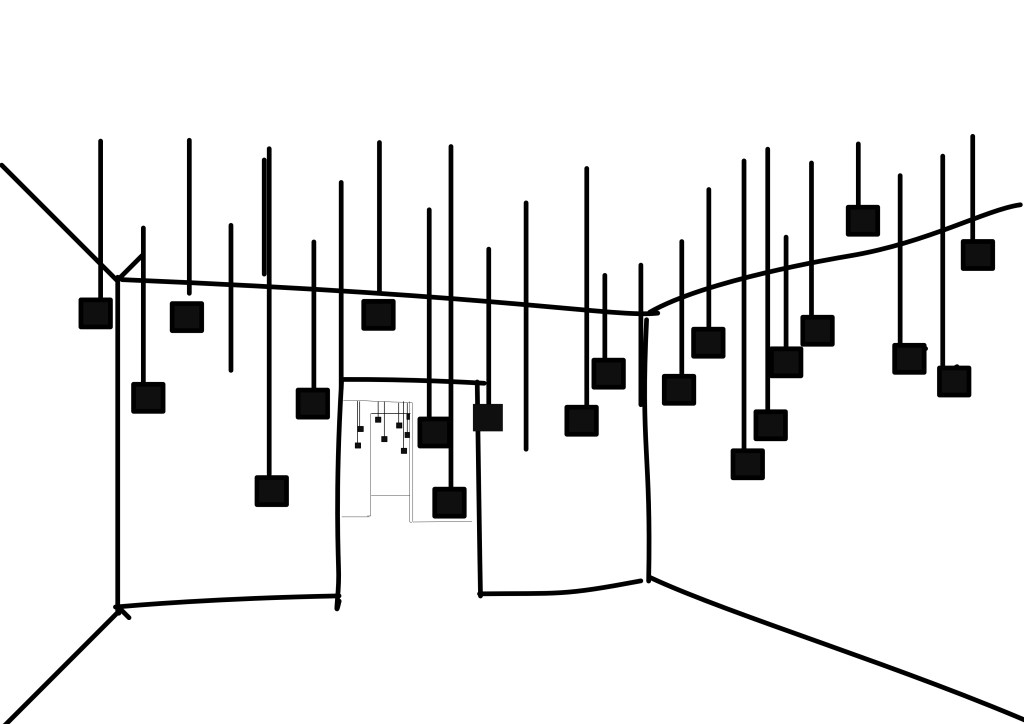
This room consists of approximately forty suspended loudspeakers arranged across two connected spaces. The speakers form a porous, forest-like architecture at varying heights. Sound circulates through them intermittently rather than continuously.
The material is composed of field recordings gathered along the border landscape of Western Thrace: wind in burned forests and wetlands, pastoral environments, infrastructural vibrations, distant artillery, train passages, and public address systems. Certain events are reinforced at low frequency through minimal subwoofer support.
Many speakers remain silent at any given moment. Sounds emerge, shift position, and dissolve. The spatial arrangement allows acoustic bleed between zones without fixed listening points. The room presents the border as an environmental condition rather than as a defined line.
Example 1 . of compositions and sounds
Example 2.
5 videos with FM transmissions
This room consists of five transmission clusters. Each cluster includes an iPad and headphones connected to a low-power FM receiver.
The transmitted material alternates between voice testimonies, spectrogram visualizations, text fragments, and minimal sound elements derived from recorded infrastructures. At times only voice is present. At times only spectral trace or text. Silence is also part of the structure.
Each cluster operates on a dedicated frequency. Visitors tune the receivers to access the transmissions. The installation tries to make audible different voices from the border by putting together human voices with sounding infrastructures dealing with topics such as the ecological catastrophe in the area, the migrant crisis, the minority and the border it self.
short examples of the material for these clusters
Then the are state witnesses, I do have a lot of recordings from public speeches and parades that are quite interesting but I do find this video as well interesting:
 eleftherioskrysalis.info
Leave a comment